

Blogs
Cordyceps: the caterpillar fungus explained, from Himalayan legend to modern supplement
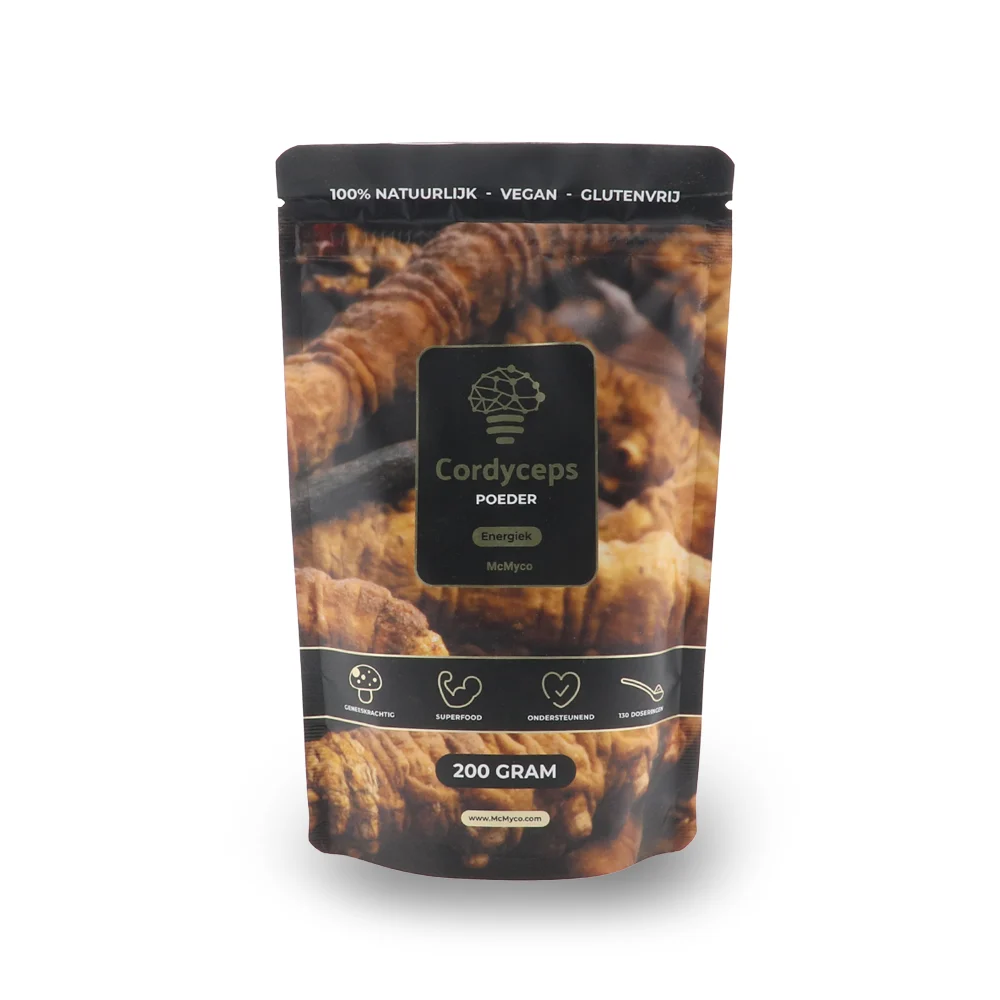
Few mushrooms have a stranger story than cordyceps. In the wild it grows out of the body of a caterpillar, high on the Tibetan plateau. In China it is so valuable that it has been called “soft gold”. And in gyms and coffee bars it is now sold as the mushroom for energy.
In this guide we look at what cordyceps really is, why the cordyceps in a supplement is usually not the same as the wild fungus, what studies in people have found and how to choose a product.

Table des matières
What is cordyceps?
Cordyceps is a group of fungi that live as parasites on insects. The spores infect a host, the fungus grows inside it and eventually a thin, club-shaped fruiting body grows out of the insect. There are hundreds of species. Two of them matter for supplements:
- Ophiocordyceps sinensis, formerly Cordyceps sinensis. This is the famous wild caterpillar fungus. It infects the larvae of ghost moths in alpine meadows at 3,000 to 5,000 metres in Tibet, Nepal and Bhutan.
- Cordyceps militaris, a bright orange relative that is much easier to grow. Most cultivated cordyceps fruiting bodies are militaris.
Cordyceps at a glance
- Chinese name: dong chong xia cao, “winter worm, summer grass”
- Tibetan name: yartsa gunbu
- Best-known compounds: cordycepin, adenosine, polysaccharides and beta-glucans
- Psychoactive? No. Cordyceps does not contain psilocybin
Winter worm, summer grass: the history
The Chinese name describes what the old herbalists thought they saw: in winter it is a worm, in summer it turns into a plant. In reality the caterpillar is infected underground in autumn and the fungal stalk breaks through the soil in spring.
Cordyceps has been part of Tibetan and Chinese traditional medicine for centuries, where it was used as a tonic for energy, the lungs and the kidneys. It became world news in 1993, when Chinese runners broke several world records and their coach credited, among other things, a tonic with cordyceps. That claim was never proven, but it gave cordyceps its sporty image.
Today wild cordyceps is collected by tens of thousands of families in the Himalayas. Because of the high demand, top quality can cost more than its weight in gold.
Wild, cultivated or mycelium: three kinds of cordyceps
Because wild Ophiocordyceps sinensis is rare and very expensive, almost all cordyceps supplements are made in another way. When you compare products, it helps to know the three main types:
| Type | How it is made | What to know |
|---|---|---|
| Wild O. sinensis | Collected by hand in the Himalayas | Rare and very expensive; risk of adulteration and heavy metals |
| Cultivated C. militaris | Fruiting bodies grown on a substrate such as rice or in liquid | Contains cordycepin; widely used in modern supplements |
| Fermented mycelium (e.g. Cs-4) | Fungal strain isolated from wild cordyceps, grown in fermentation tanks | Used in most older clinical studies |
So the label “Cordyceps sinensis” on a supplement does not always mean wild fungus. Check what the label says about the species, the part used (fruiting body or mycelium) and how it was produced.
What are cordycepin and adenosine?
Cordycepin is a molecule that looks like adenosine, a building block of the body’s energy carrier ATP. That similarity is why cordyceps is linked to energy. Cordycepin is mainly found in C. militaris. In laboratory research it affects many cell processes, but whether a supplement delivers enough of it to matter in people is not known.
What does research in people show?
Most research on cordyceps has been done in cells and animals. There are some small trials in people, mostly about exercise. The results are mixed:
| Study | Who | Result |
|---|---|---|
| Parcell et al., 2004 | 22 trained male cyclists, 5 weeks Cs-4 | No improvement in endurance or time-trial performance |
| Chen et al., 2010 | 20 healthy older adults, 12 weeks Cs-4 | Improvement in some threshold measures, not in maximal oxygen uptake |
| Hirsch et al., 2017 | 28 young adults, 1 to 3 weeks of a militaris blend | Small improvement in oxygen uptake and time to exhaustion after three weeks |
The trials are small, short and used different products, so they are hard to compare. In trained athletes the effect seems small or absent. There are no approved health claims for cordyceps in the European Union, so a supplement may not promise more energy or better performance.
If you want to read more about mushrooms and sport, Tatanka, our sister shop, has an article on that topic. Here we focus on what cordyceps is and how to choose.
Powder, drops or capsules?
At Headshop you can find cordyceps from McMyco in three forms. According to the manufacturer, all of them are made from the fruiting body.

- Powder. Le Cordyceps 200 gram powder is the most flexible option. The manufacturer gives a serving of 1.5 grams with about 75 mg of polysaccharides. Stir it into coffee, cocoa, a smoothie or hot water.
- Drops. Le Cordyceps extract drops are a liquid extract in a 50 ml bottle. Easy to take with you. Keep the bottle in the fridge after opening.
- Capsules. Le Cordyceps extract capsules contain 400 mg of extract per serving with added vitamin C and zinc. Do not exceed the daily dose of two capsules stated on the label.
Want to try several mushrooms at once? The Fantastic 5 powder combines cordyceps with chaga, lion’s mane, reishi and maitake. You do get less cordyceps per serving than with a single-mushroom product. See all medicinal mushroom supplements in our healthshop.
How to choose a good cordyceps product
- Species and part. Does the label say militaris or sinensis, and fruiting body or mycelium?
- Extract or plain powder. Hot water or alcohol extraction makes the compounds in the tough fungal cell walls more available.
- Organic and tested. Fungi easily absorb heavy metals from their surroundings. Organic cultivation and lab testing reduce that risk.
- Realistic claims. Be careful with products that promise to “dramatically” boost energy or performance. Research does not support big promises.
- Clear serving. A good label states the amount per serving and the daily maximum.
Side effects and who should be careful
In the human studies cordyceps was generally well tolerated. Mild stomach complaints, such as nausea, diarrhoea or a dry mouth, are the most common side effects.
- Cordyceps may lower blood sugar and slow blood clotting. If you use diabetes medication or blood thinners, talk to your doctor or pharmacist first.
- Because cordyceps may influence the immune system, people with an autoimmune disease or who use immunosuppressants should not use it without medical advice.
- There is no safety data for pregnancy and breastfeeding, so do not use it then.
- In 2016 Chinese food and drug authorities warned that wild cordyceps can contain far too much arsenic. Buy from a supplier who tests their products.
Always follow the serving on the label. Stop if you get complaints.
Curious about other mushrooms? Read our guides on reishi, lion’s mane, chaga et turkey tail.
Frequently asked questions about cordyceps
What is cordyceps?
Is cordyceps a psychedelic mushroom?
Does cordyceps really give you more energy?
What is the difference between Cordyceps sinensis and militaris?
Can I take cordyceps with coffee?
Who should not use cordyceps?
Sources d'information
- Memorial Sloan Kettering Cancer Center: Cordyceps
- Parcell et al. (2004), Cordyceps sinensis (CordyMax Cs-4) supplementation does not improve endurance exercise performance
- Chen et al. (2010), Effect of Cs-4 (Cordyceps sinensis) on exercise performance in healthy older subjects
- Hirsch et al. (2017), Cordyceps militaris improves tolerance to high-intensity exercise after acute and chronic supplementation
 FR
 EN
 NL
 DE
 IT
 PL
 ES
 PT