

Blog
Reishi mushroom: what it is, what research says and how to choose powder, drops or capsules
Reishi is probably the most famous medicinal mushroom in the world. In China it is called lingzhi, in Japan reishi, and in old texts it carries nicknames like “mushroom of immortality”. Today you will find it in powders, coffee blends, drops and capsules.
But what is reishi exactly, what does science actually know about it, and what is the difference between all those products? In this guide we stick to the facts, so you can make your own choice.

Indice dei contenuti
What is reishi?
Reishi is the common name for the lacquered bracket fungi of the genus Ganoderma, usually sold as Ganoderma lucidum o Ganoderma lingzhi. In Dutch it is called lakzwam, after the glossy, varnished look of its cap. The mushroom is reddish brown to dark red, grows on the stumps and roots of deciduous trees such as oak and beech, and has a woody, kidney-shaped cap.
Unlike a button mushroom or a shiitake, reishi is not a culinary mushroom. It is hard, tough and very bitter. That is why it has traditionally been used as a tea or decoction, and why today you mainly find it as a powder or an extract.
Wild reishi is rare, so almost all reishi on the market is cultivated on logs, sawdust or wood chips.
Reishi in Chinese and Japanese tradition
Reishi has held a special place in traditional Chinese medicine for more than 2,000 years. It appears in the classic herbal text Shennong Bencao Jing, where it was ranked among the “superior” herbs that could be used for a long time. The mushroom became a symbol of long life, good fortune and spiritual strength, and you can still see it in Chinese art, carvings and on temple decorations.
From China the use spread to Japan and Korea. In these traditions reishi was not used for one specific complaint, but as a general tonic for vitality and balance, often over a long period.
What is in reishi?
Reishi contains a wide range of compounds. The two groups that get the most attention are:
- Polysaccharides, including beta-glucans. These long sugar chains from the cell walls of the mushroom are the most studied components. Supplements often state how many polysaccharides or beta-glucans a serving contains.
- Triterpenes (such as ganoderic acids). These are responsible for the typical bitter taste. A very bitter reishi product is often a sign of a higher triterpene content.
Reishi also contains sterols, proteins, peptides, nucleosides and minerals. Which of these is responsible for which effect is still not clear.
What does research say?
There is a lot of laboratory and animal research on reishi. Studies in cells and animals point to possible effects on the immune system, inflammation, blood sugar and blood pressure. That sounds promising, but results in a test tube or a mouse do not automatically apply to people.
Good human research is scarce. A Cochrane review of reishi in cancer patients concluded that there was not enough evidence to use it as a treatment, and that the quality of the available studies was low. Small human trials on other topics often show mixed or modest results. The US LiverTox database sums it up neatly: none of the claimed benefits has been proven in adequately sized and properly controlled clinical trials in humans.
Our honest advice: see reishi as a traditional mushroom with an interesting research profile, not as a medicine. Do not use it as a replacement for treatment from your doctor.
Powder, drops or capsules: which form suits you?
At Headshop you will find reishi in several forms. Which one suits you mostly depends on how you want to use it.
Reishi powder
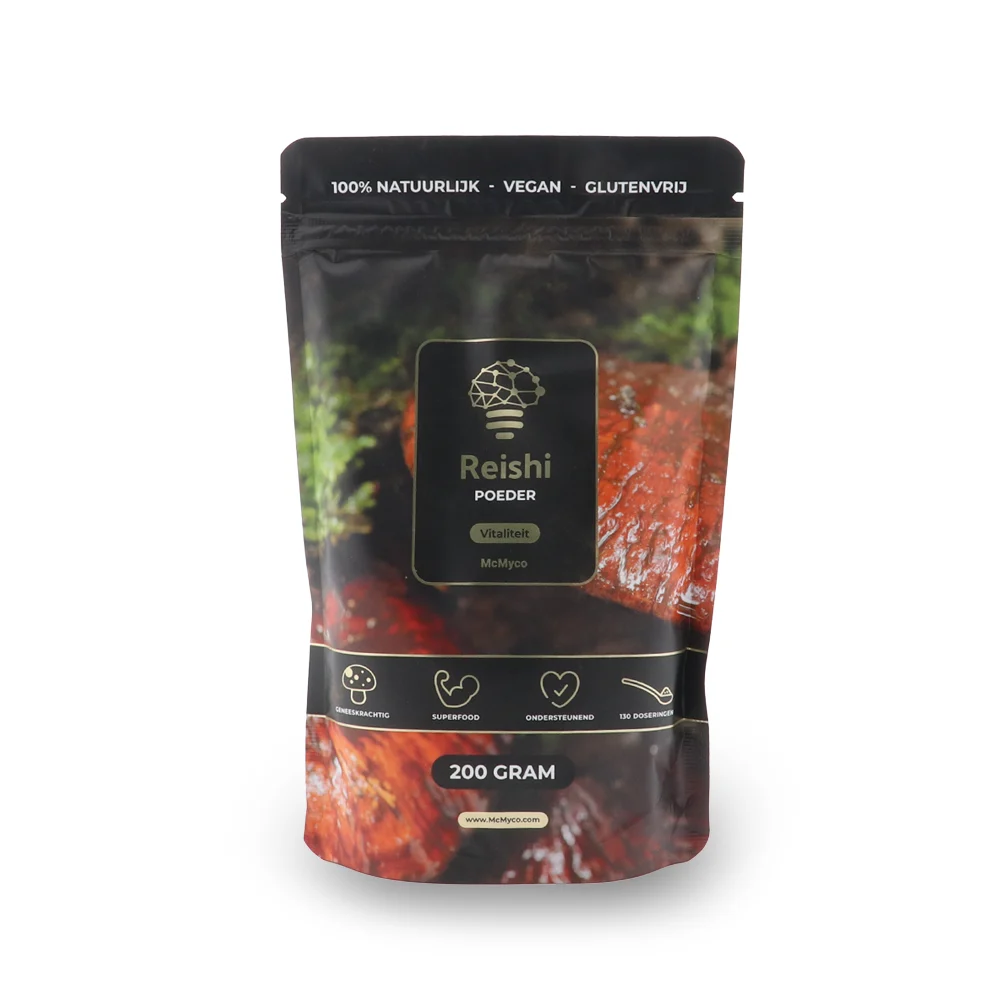
Il McMyco Reishi 200 gram powder is made from the fruiting body of the mushroom. The manufacturer states about 75 mg of polysaccharides and beta-glucans per 1.5 gram serving. Powder is flexible: you can stir it into hot water, coffee, cocoa or a smoothie. Do expect a bitter, earthy taste.
Reishi extract drops
Il McMyco Reishi extract drops are a liquid extract in a 50 ml dropper bottle. Drops are easy to take along and to dose precisely, and many people find them easier to use than a powder.
Reishi capsules
Do not like the taste at all? Then Reishi Extract Capsules are the most practical option. You swallow them with water, so you do not taste the bitterness.
Mushroom blends
Reishi is also part of blends such as Fantastic 5 (chaga, cordyceps, lion’s mane, reishi and maitake) and Essential 8. A blend is useful if you want to try several mushrooms at once, but you get less reishi per serving than with a single-mushroom product.
Whatever form you choose, always follow the serving on the label and do not take more than the manufacturer advises.
Reishi at Headshop
How to recognise a good reishi product
Reishi products differ a lot in quality. These points help you compare:
- Fruiting body or mycelium? Products made from the fruiting body (the actual mushroom) are the traditional choice. Products based on mycelium grown on grain can contain a lot of starch from the substrate.
- Extract or plain powder? The cell walls of reishi are hard to digest. An extract (with hot water and/or alcohol) makes the compounds more available than ground mushroom alone.
- Stated content. A serious brand states the amount of polysaccharides or beta-glucans per serving.
- Organic and tested. Mushrooms can absorb heavy metals from their substrate. Organic cultivation and lab testing reduce that risk.
Side effects and who should be careful
Reishi is generally well tolerated in short studies, but it is not without risks. Reported side effects include an upset stomach, nausea, dry mouth, itching, dizziness and trouble sleeping. In rare cases, liver problems have been reported with reishi powder. Stop immediately and contact a doctor if you notice yellowing of the skin or eyes, dark urine or pain in the upper abdomen.
Be extra careful, and talk to your doctor or pharmacist first, if you:
- take blood thinners or have a bleeding disorder, or have surgery planned (reishi may increase the risk of bleeding);
- take medication for blood pressure or diabetes (the effects could add up);
- use immunosuppressants, for example after a transplant;
- are pregnant or breastfeeding, since there is no safety data for this group.
Reishi compared with other medicinal mushrooms
Reishi is often mentioned together with other mushrooms. Lion’s mane is usually associated with focus and the brain, chaga with antioxidants, and turkey tail with the immune system. Read more in our articles about the Lion’s Mane mushroom, the chaga mushroom e Turkey Tail.
Reishi traditionally has a reputation as the “calming” mushroom of the group, which is why many people take it in the evening. That is tradition, not a proven effect, so see for yourself how it suits you.
Frequently asked questions about reishi
What is reishi used for?
Is reishi the same as lingzhi?
Can you eat reishi like a normal mushroom?
What is the difference between reishi powder and reishi extract?
Does reishi have side effects?
Is reishi a psychedelic mushroom?
Fonti
- Memorial Sloan Kettering Cancer Center: Reishi mushroom
- LiverTox (NCBI): Lingzhi, Reishi
- Cochrane: G. lucidum (reishi mushroom) for cancer treatment
- Merck Manual: Reishi
 IT
 EN
 NL
 DE
 FR
 PL
 ES
 PT